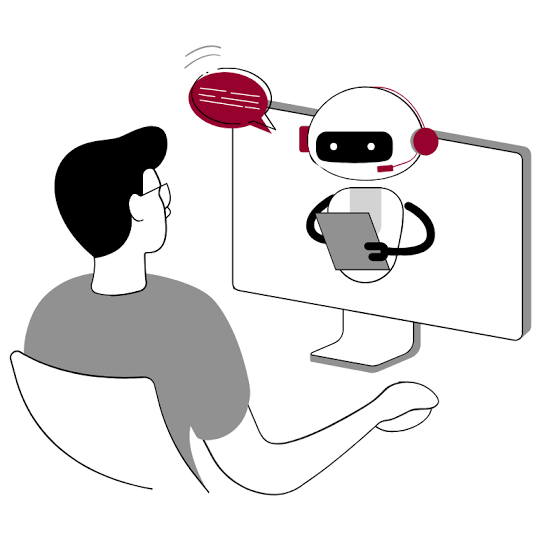
If you have ever opened the chat on a company website, you know how it ends: you pick options from a menu, none of them match your case, and you end up writing an email anyway. The bot knew nothing about the company. It was just reciting a script.
When we built the assistant on this site we set one rule: if it is not genuinely useful, it does not ship. It is in the bottom-right corner. Open it, ask it anything about us, and come back when you are done.
Here is what is inside, and why it matters for your business.
The problem is not AI, it is what AI does not know
ChatGPT and Claude write beautifully, but they do not know your catalogue, your lead times or your terms. A chatbot plugged into a model and little else is a brilliant intern on day one: endlessly articulate, zero context.
The technique that fixes this is called RAG. In plain terms: before answering, the assistant searches its own knowledge base and replies with what it finds there. It stops improvising and starts talking about your business.
Our knowledge base updates itself
This is the part we are proudest of. The knowledge base is not written by hand: it is generated from the website's own content. Every service, every automation in our catalogue, every FAQ and every blog article is split into chunks, turned into vectors and stored.
What does that mean in practice? When we change a text on the site, the assistant learns the change. Nobody has to remember to update two different places, which is exactly how these projects rot: the website says one thing and the bot has been saying something else for eight months.
When you ask a question, the system finds the chunks closest to it and hands them to the model as reference material. That is why it can tell you who owns the code of a project, or which analogy we use to explain MCP servers: it does not know it by heart, it looked it up.
It knows when to stop talking and act
An assistant that only chats is a brochure that answers back. Ours can do things.
If it senses you want us to contact you (you ask for a quote, a meeting, or you simply say so), it does not fob you off with "email hello@mitteva.com". It opens a form inside the chat itself, and when you send it that contact lands straight in our system along with a summary of what you are interested in, written by the assistant.
This is called tool calling: the model does not just generate text, it decides when to use a tool. We gave it one and explained when to use it. It decides the rest.
The detail that makes the difference: it never asks for your email in plain text. Either it opens the form, or it does not ask.
It makes nothing up, and it tells you it is an AI
Two rules we do not negotiate.
No inventing. Prices, deadlines, discounts, client names: if it is not in the knowledge base, it does not pull it out of thin air. It tells you it does not know and hands you to a human. A chatbot that improvises a price is not a chatbot, it is a liability.
It says it is an AI. It carries the badge, it says so when it greets you, and if you ask whether it is human it answers that it is not. This is not politeness: the European AI Act requires telling people they are talking to a machine, and we would rather comply from day one than scramble later.
It also has limits. It only talks about Mitteva and technology. Ask it for a cake recipe and it will politely tell you that is not its job.
What does it cost to run?
Less than people imagine. Answering a question costs a fraction of a cent. Rebuilding the entire knowledge base costs less than a coffee.
The expensive part is never the model. The expensive part is wiring it properly into your business, deciding what it can and cannot do, and making sure it never says something silly in front of a customer.
What this would do in your company
Swap "Mitteva" for your business and the same design solves very different problems:
- A shop that answers about stock, lead times and returns from real data, not a PDF from last year.
- An accounting firm whose assistant answers from its own manuals and circulars.
- An industrial company whose team queries the technical documentation in plain language instead of digging through folders.
- Anyone who wants to capture customers without losing the one who arrives at 23:40 and will not fill in a form.
And it works internally too: the same engine can answer your own team's questions about your procedures.
Try it before you believe us
It is in the bottom-right corner. Ask it what automations we build, what an MCP server is, or whether we lock you into a contract. You will feel the difference between a menu bot and an assistant that knows the business.
If it fits your company, tell us what you need on our contact page or write to hello@mitteva.com. The initial assessment is free. You can also ask the assistant itself: it already knows what to do.